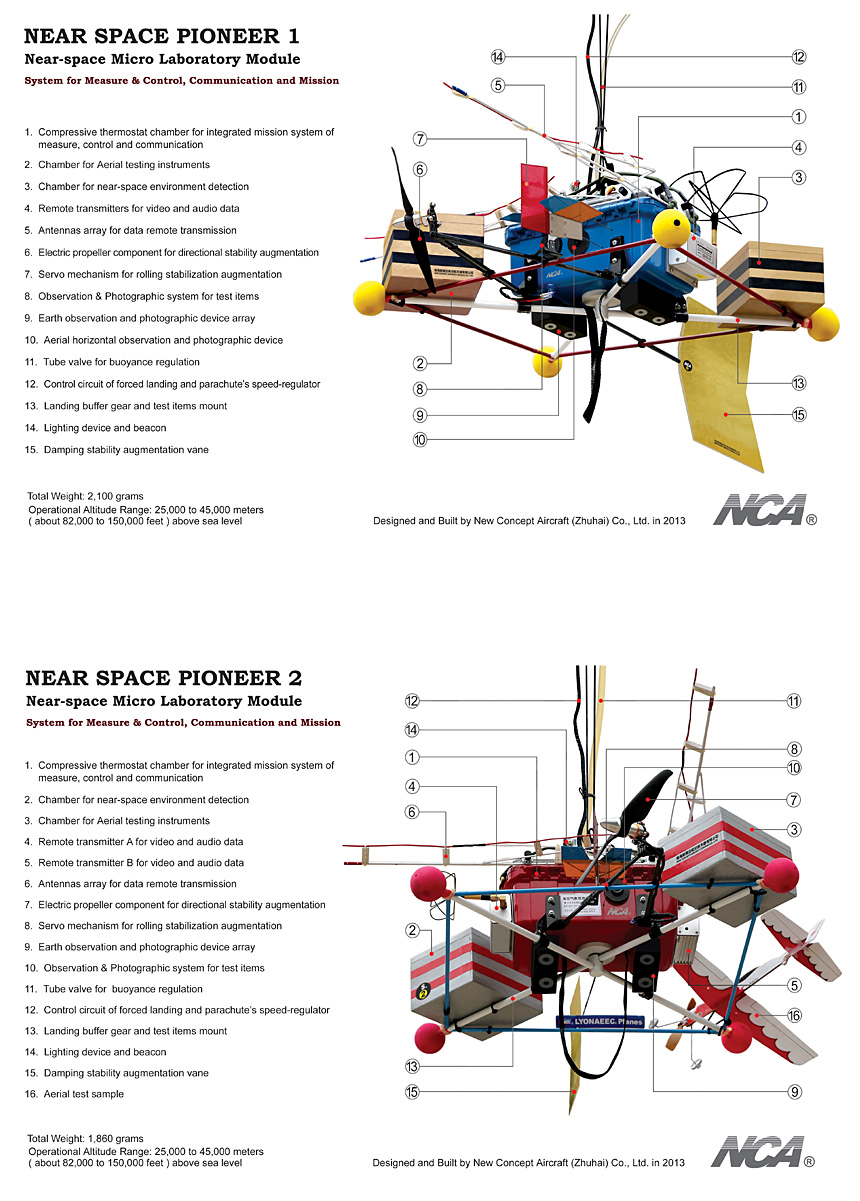
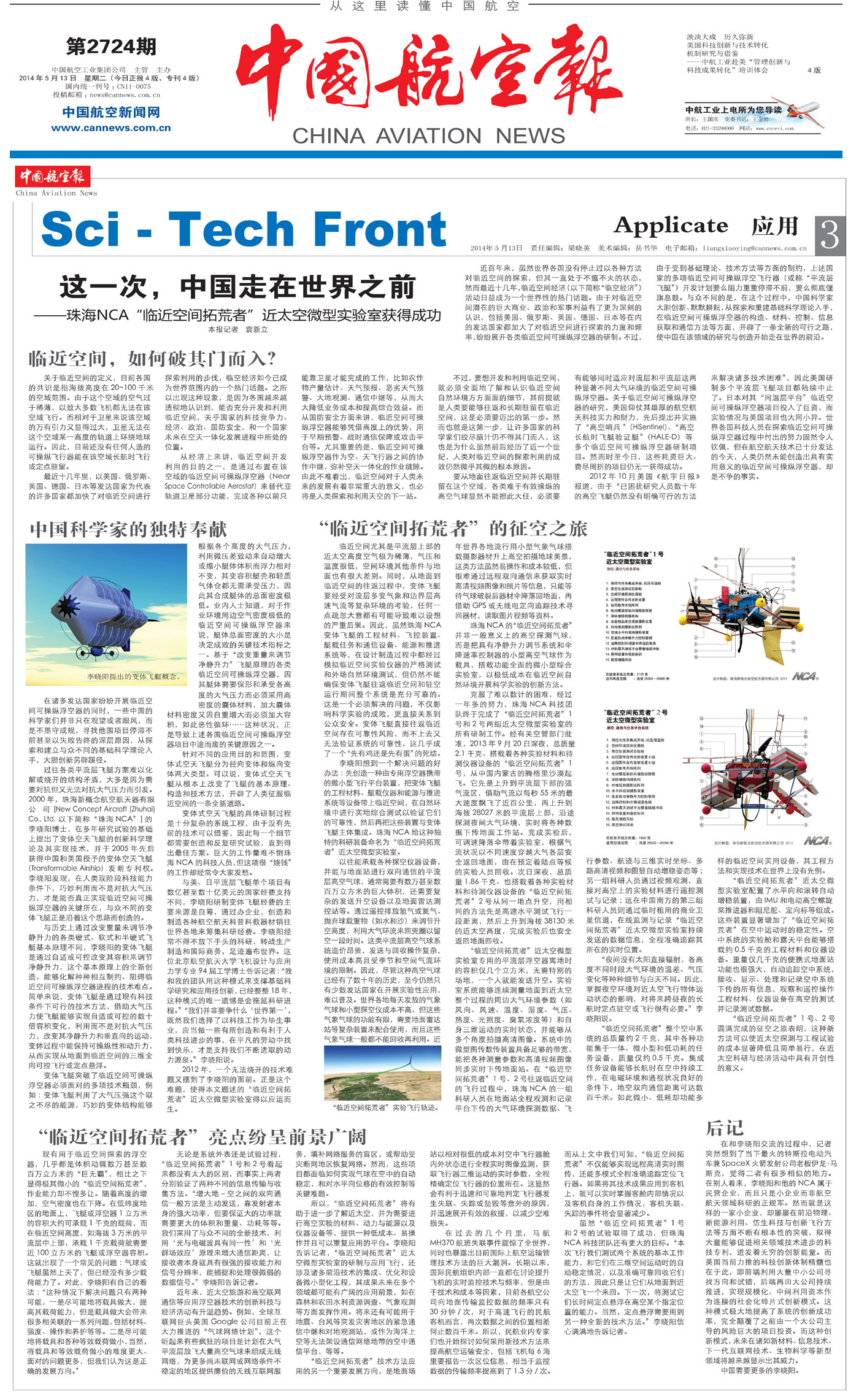
In 2012, driven by the needs of near-space technology and economic development, New Concept Aircraft (Zhuhai) Co., Ltd. (abbreviated as Zhuhai NCA) created two sets of micro-equipment dedicated to near-space exploration, communication, and mission operations: the "Near-Space Pioneer" micro-laboratory. In 2013, Near-Space Micro-Laboratories No. 1 and No. 2 successfully conducted round-trip flight application tests from ground level to an altitude of 40,000 meters in Inner Mongolia and neighboring provinces of China.
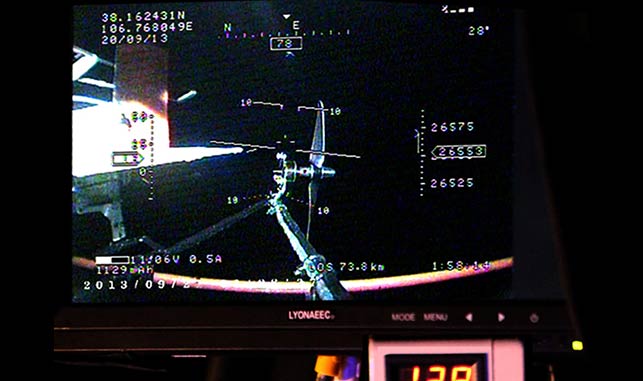
As a world-first innovation by Zhuhai NCA, the "Near-Space Pioneer" micro-laboratory represents a cost-effective approach to advancing near-space technology and related economic activities. The laboratory system is capable of real-time three-dimensional self-positioning, detecting and recording various atmospheric data in its airspace, capturing multi-angle video footage of both spatial and geographical environments, and maintaining long-distance bidirectional ground-to-air communication — downlinking real-time information while uplinking mission commands. Moreover, leveraging video and remote-control technologies, it enables applied testing of onboard experimental instruments and engineering materials under near-space environmental conditions.
The "Near-Space Pioneer" serves as a pathfinding pioneer for humanity's development and utilization of near-space resources. It not only facilitates sustained and in-depth understanding of various aspects of near-space, but also provides a low-cost, easy-to-operate, and reusable experimental platform for materials, power and energy systems, instruments, and equipment requiring high-altitude testing.
Furthermore, the technological approach and engineering methodolofy behind the "Near-Space Pioneer" hold broad application prospects across multiple fields. For instance, it could play a role in forest and agricultural water resource surveys, meteorological observation, and more. It also shows promise as an emergency communication relay and earth observation station in areas affected by sudden disasters such as earthquakes and typhoons, or as an aerial communication platform over regions like oceans where establishing ground-based networks is impractical.
Another important direction for applying the "Near-Space Pioneer" technology is enabling ground stations to conduct real-time visual monitoring of both interior and exterior of airborne vehicles at relatively low cost, while acquiring real-time three-dimensional motion parameters and accurately locating the vehicles' position throughout its flight. This capability would clearly contribute to quickly and reliably determining the causes of incidents such as loss of contact, disappearance, or crashes, thereby facilitating prompt and effective rescue operations and reducing the losses associated with air disasters.
 Integrated-wing high
 Robotic gecko &
  Long endurance
  Machine Butterfly,
  "Near Space Pioneer" micro lab
 Transformable airship
 Optical science &
  Commercial Fixed-wing
  Mirror-Array PV (MA-PV)
 Marine engineering equipment
  Underwater lift with large load and lower consumption
  Transformable submarine
 Device for development and utilization of waste heat energy
  Integrated microgrid system
 Device for waste gas (steam) - cleaning
  Climbing robot for highrise fire-fighting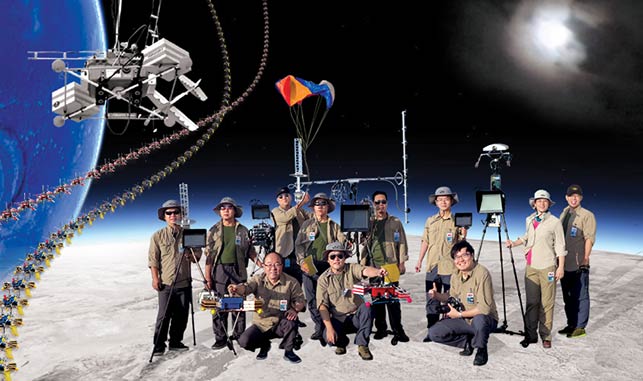






 粤公网安备 44049002000305号